
Last reviewed: October 2026
Not long ago, creatine was something you’d only find on the top shelf of a bodybuilding store. Now it’s everywhere — in podcasts, social media feeds, and supplement aisles marketed to women in menopause and adults over 50. Searches for “creatine for women” have grown sharply over the past two years. So is this a genuinely useful tool for aging muscles, or just the latest wellness fad? The honest answer sits in between. Creatine is one of the most-studied supplements in the world, and for adults over 50 the evidence is real — but more specific, and more modest, than many headlines suggest.

What Creatine Actually Is
Creatine is a compound your body makes naturally from amino acids, mostly in the liver and kidneys. You also get some from meat and fish. About 95% of it is stored in your muscles, where it helps recycle ATP — the molecule your cells use for quick bursts of energy, like standing up from a chair, climbing stairs, or lifting a bag of groceries.
Taking creatine as a supplement tops up those muscle stores. That doesn’t build muscle on its own. What it does is help muscles do a little more work during each training session — a few extra repetitions, slightly more effort — and over weeks and months that extra work can add up.
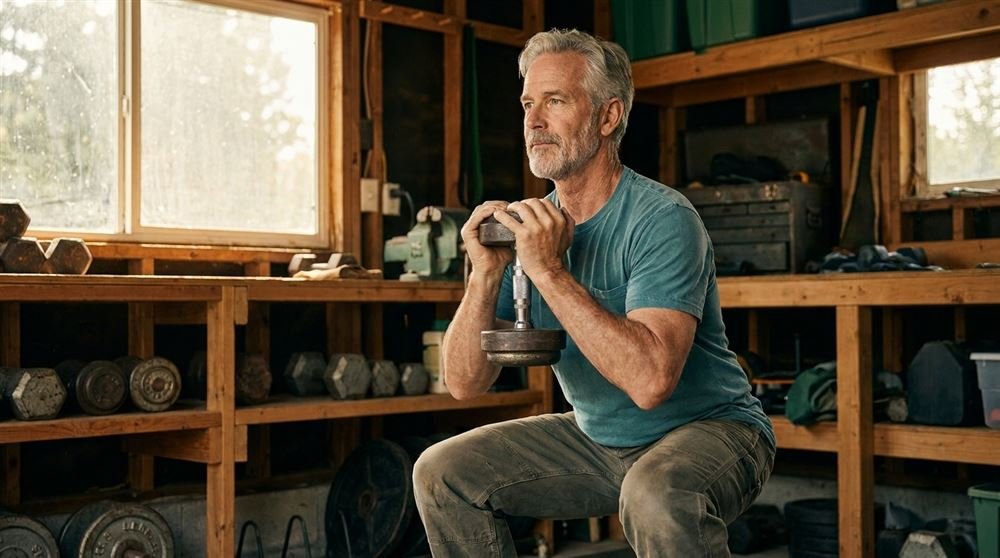
That detail matters, because it explains the most important finding in the research: creatine works best when paired with strength training, not as a replacement for it.
What the Research Shows for Muscle and Strength After 50
The strongest evidence comes from studies that combined creatine with resistance training in older adults.
- A 2017 meta-analysis in the Open Access Journal of Sports Medicine (Chilibeck et al.) pooled 22 randomized trials with 721 participants, average age 57 to 70. People who took creatine while strength training 2–3 days a week gained about 1.37 kg (roughly 3 lb) more lean mass than those who took a placebo, along with greater gains in chest press and leg press strength.
- An earlier 2014 meta-analysis in Medicine & Science in Sports & Exercise (Devries & Phillips) reached a similar conclusion: creatine plus resistance training produced more lean mass and more upper- and lower-body strength than training alone.
Three pounds of lean mass may not sound dramatic, but for adults who lose an estimated 3–8% of their muscle per decade after 30, it’s a meaningful buffer. We explain why that muscle matters so much for energy and weight in Why Your Metabolism Really Slows Down After 50.
The catch: almost all of these benefits were seen in people who were also lifting. Creatine without training has much weaker evidence. If you’re not strength training yet, that’s the place to start — our free 2-day strength plan is built for exactly this age group, and two short sessions a week are enough to get results.

Creatine and Menopause: Separating Hope From Hype
Much of the recent buzz is aimed at women in perimenopause and menopause, when falling estrogen speeds up both muscle and bone loss. Some of that interest is justified — and some of it gets ahead of the evidence.
The most rigorous test so far is a 2-year randomized trial of 237 postmenopausal women (average age 59) published in Medicine & Science in Sports & Exercise in 2023 (Chilibeck et al.). All participants did resistance training three days a week and walked six days a week; half took creatine (0.14 g per kilogram of body weight per day — about 10 grams for a 155-lb woman) and half took a placebo.
The results were mixed:
- Bone density: creatine did not improve bone mineral density at the hip or spine compared with placebo.
- Bone shape: it did improve some measures of bone geometry at the hip, which may relate to strength, though what this means for fracture risk is not yet known.
- Muscle and walking: the creatine group gained more lean mass and walked faster than the placebo group.
So the fair summary is: creatine may help women in menopause hold onto muscle when combined with training, but it should not be thought of as a bone-density treatment. If bone health is your concern, talk with your doctor about screening and proven options. For more on what changes during this stage, see What Hormone Decline After 50 Actually Affects.
Brain Health, Safety, and Common Myths
Memory and thinking. Your brain uses creatine too, and this is an active area of research. A 2018 systematic review in Experimental Gerontology (Avgerinos et al.) looked at six trials with 281 people and found some evidence that creatine may improve short-term memory and reasoning, with possibly larger effects in older adults. Results for other areas of thinking were inconsistent. It’s promising, but not proven.
Safety. The International Society of Sports Nutrition’s 2017 position stand (Kreider et al.) concluded there is no scientific evidence that creatine monohydrate harms healthy people at recommended doses, in either short- or long-term use. A few practical notes:
- Creatine can raise creatinine on a routine blood test, which may look like a kidney problem when it isn’t. Tell your doctor you take it.
- If you have kidney disease, diabetes with kidney involvement, or take medications that affect the kidneys, check with your doctor first.
- Some people notice a small weight gain early on — usually water stored in the muscles, not fat.
The hair-loss myth. This worry traces back to a single 2009 study of 20 rugby players that found a rise in DHT, a hormone linked to hair loss. That study never actually measured hair. A 2025 randomized trial in the Journal of the International Society of Sports Nutrition (Lak et al.) tested it directly: after 12 weeks of 5 grams a day, there was no difference from placebo in DHT, testosterone, or any hair measurement.
How to Use Creatine After 50 (If You Choose To)
- Form: plain creatine monohydrate is the form used in nearly all the research. More expensive “advanced” versions haven’t been shown to work better.
- Dose: most studies use 3–5 grams a day — roughly one level teaspoon of powder. A “loading phase” of higher doses isn’t necessary; it just fills your muscles faster.
- Timing: whatever time you’ll remember. Consistency matters more than timing.
- Quality: supplements aren’t tightly regulated in the US. Look for third-party testing seals such as NSF Certified for Sport or USP Verified.
- The foundation: creatine works on top of strength training and enough protein — not instead of them. See How Much Protein You Really Need After 50.
What we would buy
Plain creatine monohydrate powder, not gummies
Independent lab tests have found that some creatine gummies contain little to no creatine, while plain powders reliably match their labels. You don’t need anything fancy: one scoop (3–5 g) a day in water or coffee.
Best seller: Nutricost Micronized Creatine Monohydrate, the #1 best-selling creatine on Amazon. Simple and inexpensive per serving. The company says every batch is tested by independent ISO-accredited labs, but it does not carry an NSF or Informed Sport seal.
If you want a certified seal: Thorne Creatine is NSF Certified for Sport, the strictest seal we mentioned above. It costs more per serving.
As an Amazon Associate, Master Vitality earns from qualifying purchases, at no extra cost to you. Talk to your doctor before starting any supplement, especially if you have kidney problems.
Frequently Asked Questions
Is creatine safe for adults over 50?
For healthy adults, research to date shows creatine monohydrate is safe at recommended doses. If you have kidney problems or take medications that affect the kidneys, talk with your doctor before starting.
Should women in menopause take creatine?
It may help preserve muscle when combined with strength training, which is valuable during menopause. A large 2-year trial did not find that it improves bone density, so it isn’t a substitute for bone-health care.
Does creatine work without exercise?
The evidence is much weaker. Nearly all the muscle and strength benefits in older adults were seen when creatine was paired with regular resistance training.
Does creatine cause weight gain or hair loss?
Some people gain a pound or two of water weight in the muscles at first. A 2025 randomized trial found no effect on hair or hair-related hormones.
The Takeaway
Creatine isn’t a miracle, and it isn’t hype either. For adults over 50 who are already strength training — or ready to start — it’s an inexpensive, well-studied supplement that may help you build a bit more muscle and strength than training alone. For women in menopause, it may help protect muscle, but it doesn’t replace bone-health care. If you take it, keep it simple: plain creatine monohydrate, 3–5 grams a day, alongside regular training and enough protein. And if you’re not lifting yet, the training itself is the bigger win — start with our guide to starting strength training safely at home.
Free: The 2-Day Strength Plan for Adults Over 50
A simple 4-week, at-home routine: two short sessions a week, no gym required. Includes the CDC chair-stand test and a printable progress sheet.
You will also get our occasional research-based health emails. Unsubscribe anytime. See our Privacy Policy.
Sources
- Chilibeck PD, Kaviani M, Candow DG, Zello GA. “Effect of creatine supplementation during resistance training on lean tissue mass and muscular strength in older adults: a meta-analysis.” Open Access Journal of Sports Medicine (2017). doi:10.2147/OAJSM.S123529
- Devries MC, Phillips SM. “Creatine supplementation during resistance training in older adults: a meta-analysis.” Medicine & Science in Sports & Exercise (2014). doi:10.1249/MSS.0000000000000220
- Chilibeck PD et al. “A 2-year randomized controlled trial on creatine supplementation during exercise for postmenopausal bone health.” Medicine & Science in Sports & Exercise (2023). doi:10.1249/MSS.0000000000003202
- Avgerinos KI et al. “Effects of creatine supplementation on cognitive function of healthy individuals: a systematic review of randomized controlled trials.” Experimental Gerontology (2018). sciencedirect.com
- Kreider RB et al. “International Society of Sports Nutrition position stand: safety and efficacy of creatine supplementation in exercise, sport, and medicine.” Journal of the International Society of Sports Nutrition (2017). doi:10.1186/s12970-017-0173-z
- Lak M et al. “Does creatine cause hair loss? A 12-week randomized controlled trial.” Journal of the International Society of Sports Nutrition (2025). doi:10.1080/15502783.2025.2495229
This article is for educational purposes only and is not a substitute for professional medical advice. Always consult your doctor before making changes to your diet, exercise, or supplement routine. Some links on this site may be affiliate links, meaning we may earn a small commission at no extra cost to you.