
Last reviewed: September 2026
Maybe your doctor mentioned it at your last checkup. Maybe you noticed that getting up from a low couch takes a little more effort than it used to, or that carrying groceries up the stairs leaves your legs heavier than before. Either way, you’ve heard that strength training matters after 60 — but the idea of a gym, heavy barbells, or getting hurt keeps it on the “someday” list. The good news is that you don’t need a gym, and you don’t need to start heavy. You need a safe starting point, a handful of basic movements, and a plan to progress slowly. Here’s what the research says, and how to begin at home this week.
Why Strength Training Matters More After 60
Muscle strength isn’t about looks at this stage of life. It’s about getting out of a chair without using your hands, carrying your own bags, catching yourself when you trip, and staying independent for as long as possible.
The evidence for starting — even late — is strong:
- It works at any age. In a classic 1990 study in JAMA, Maria Fiatarone and colleagues gave ten frail nursing-home residents, average age 90, eight weeks of strength training. The nine who finished increased their leg strength by an average of 174%, grew their thigh muscle by about 9%, and walked 48% faster in a balance-walking test. If people in their nineties can respond like that, so can you.
- It’s linked to a longer life. A 2022 meta-analysis in the British Journal of Sports Medicine (Momma et al.) pooled cohort studies and found that muscle-strengthening activities were associated with a 10–17% lower risk of death from all causes, heart disease, and cancer. The biggest benefit appeared at roughly 30–60 minutes per week — not hours in the gym.
- It helps prevent falls. A 2019 Cochrane review of 108 trials and more than 23,000 older adults (Sherrington et al.) found that exercise programs reduced the rate of falls by about 23%. The most effective programs focused on balance and functional movements, often combined with resistance exercise.
This is also why the official U.S. guidelines, summarized by the CDC, recommend that adults 65 and older do muscle-strengthening activities on at least 2 days a week, alongside about 150 minutes of moderate activity such as brisk walking and some balance work. If that sounds like a lot, it isn’t — we explain why in why two sessions a week is enough.
Before You Start: Simple Safety Steps
Strength training is generally safe for older adults when it’s introduced gradually. The National Strength and Conditioning Association’s 2019 position statement on resistance training for older adults (Fragala et al.) concluded that properly designed programs are appropriate even for people with frailty, sarcopenia, and many chronic conditions. A few sensible precautions make a big difference:
- Talk to your doctor first if you have heart disease, uncontrolled blood pressure, recent surgery, joint replacements, osteoporosis, or dizziness. Ask directly: “Is there anything I should avoid?” Most people will get a green light with a few modifications.
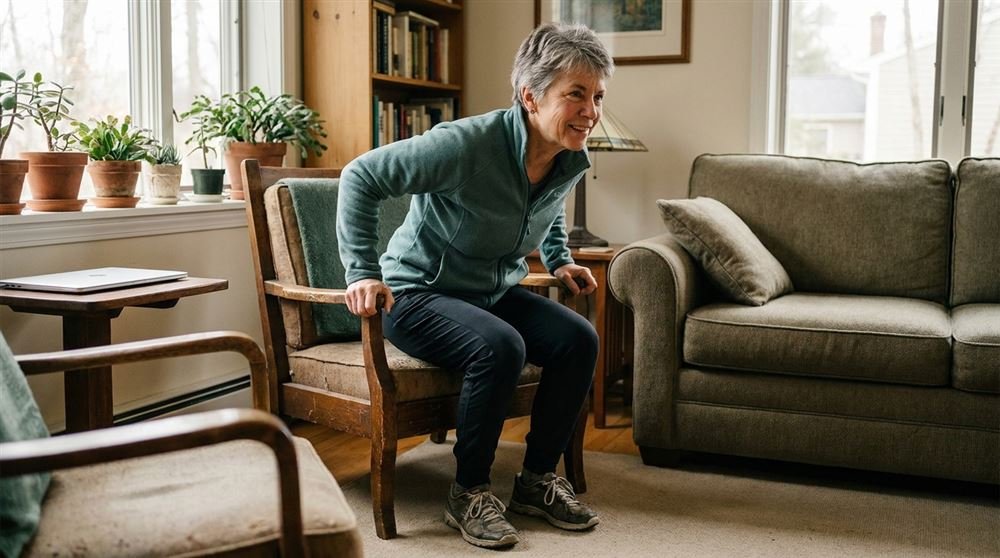
- Test your starting point. A simple way is the 30-second chair stand test, developed by Roberta Rikli and C. Jessie Jones. Sit in a sturdy chair, arms crossed over your chest, and count how many times you can stand up fully and sit back down in 30 seconds. In their large sample of older adults, typical scores for people in their early 60s were roughly 12–17 for women and 14–19 for men, and fewer than 8 unassisted stands was linked to lower functional ability.
- Set up a safe space. Use a sturdy chair that won’t slide (put it against a wall), wear supportive shoes, and keep a countertop within reach for balance.
- Know when to stop. Muscle effort and mild soreness the next day are normal. Sharp joint pain, chest pain, unusual shortness of breath, or dizziness are not — stop and contact your doctor.
And about bones: many people with low bone density are afraid that lifting will cause a fracture. In the LIFTMOR trial (Watson et al., Journal of Bone and Mineral Research, 2018), postmenopausal women with low bone mass did supervised, progressively heavy strength training twice a week for eight months. The training improved bone density and physical function, with no bone injuries reported. That trial was supervised by trained staff, so at home the lesson is not “lift heavy on day one” — it’s that well-planned strength work is protective, not dangerous.
A Beginner Home Routine (No Gym Needed)
You can train every major muscle group with a chair, a wall, and eventually a resistance band or a pair of light dumbbells. Start with one set of 8–12 repetitions of each exercise, two days a week, with at least one rest day in between.
- Sit-to-stand (legs and hips). Sit near the front of a sturdy chair, feet flat, and stand up without using your hands if you can. Sit back down slowly, taking about three seconds. Use your hands on the armrests at first if needed.
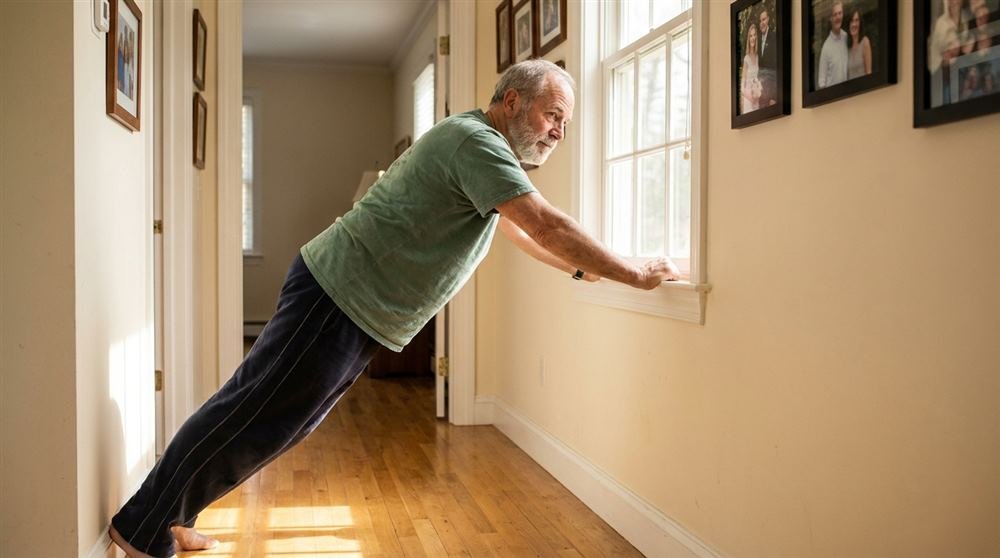
- Wall push-up (chest, shoulders, arms). Stand arm’s length from a wall, hands at shoulder height, and bend your elbows to bring your chest toward the wall, then push back. Move your feet farther away to make it harder, or progress later to a kitchen counter.
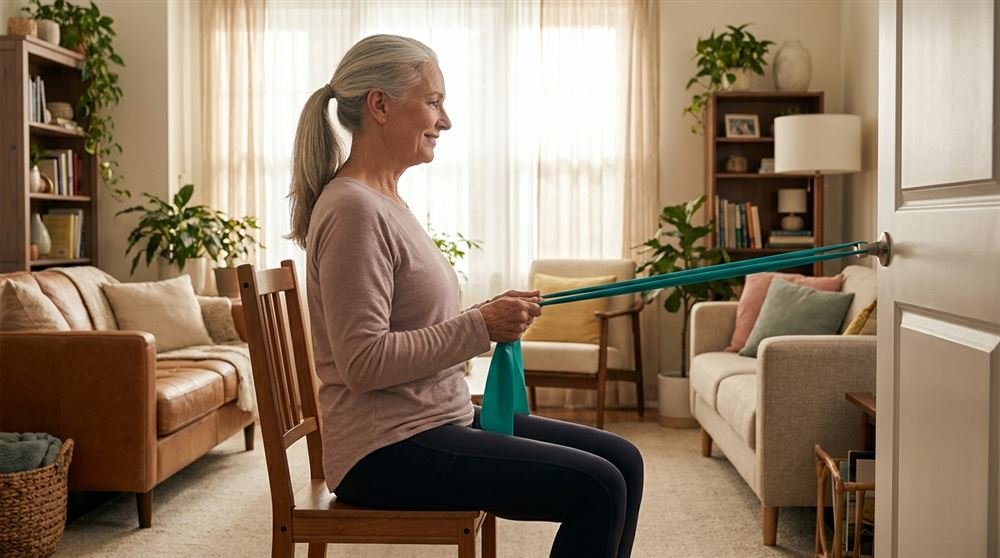
- Band or dumbbell row (upper back). Loop a resistance band around a sturdy door handle or post, or hold a light dumbbell while supporting yourself on a counter, and pull your elbow back while squeezing your shoulder blade.
- Standing calf raise (ankles and calves). Hold the back of a chair or the counter and rise onto your toes, then lower slowly.
- Hip abduction or side step (outer hips). Holding the counter, lift one leg out to the side and lower it with control.
- Supported single-leg stand (balance). Hold the counter and lift one foot for up to 30 seconds per side. As it gets easier, hold on with one finger instead of your whole hand.
Worried that bands aren’t “real” training? A 2019 meta-analysis in SAGE Open Medicine (Lopes et al.) found no meaningful difference in strength gains between elastic resistance and conventional weights or machines.
If you’d like a structured version of this, our free strength plan for adults 50+ lays out week-by-week sessions you can follow at home.
How to Progress Without Getting Hurt
The body adapts to what you ask of it — so the goal is to ask for a little more, slowly. The CDC’s guidance is to work each muscle until it’s hard to do another repetition with good form, and the NSCA position statement recommends progressing gradually over time toward 2–3 sets per exercise.
A simple, safe way to progress:
- Weeks 1–2: One set of each exercise. Focus only on smooth, controlled form. You should finish feeling like you could have done 2–3 more reps.
- Weeks 3–6: When 12 reps feel manageable, add a second set, or make the exercise slightly harder — a lower chair, a firmer band, feet farther from the wall.
- After 6–8 weeks: Consider adding light dumbbells or a third set. Retest your 30-second chair stand and compare it with your first score.
Rules that keep you safe: change only one thing at a time; breathe out as you push or stand and never hold your breath; and if a joint complains, reduce the range of motion rather than pushing through pain.
Two more things make your training pay off. First, getting enough protein gives your muscles the raw material to respond. Second, you don’t need long sessions — research on the minimum effective dose of strength training shows that short, consistent workouts deliver most of the benefit.
Frequently Asked Questions
Is it too late to start strength training at 60, 70, or older?
No. Studies in people in their 70s, 80s, and even 90s show meaningful gains in strength and mobility within a few weeks. Starting later simply means starting gently and progressing more gradually.
How many days a week should seniors do strength training?
The U.S. Physical Activity Guidelines recommend at least 2 non-consecutive days per week that work all major muscle groups. Two 20- to 30-minute sessions is a realistic, effective target for most beginners.
Can you build muscle at home without weights?
Yes, especially as a beginner. Bodyweight movements like sit-to-stands and wall push-ups are challenging at first, and resistance bands produce strength gains similar to conventional weights. As you get stronger, bands or light dumbbells help you keep progressing.
What is the best strength exercise for seniors?
If you pick just one, make it the sit-to-stand. It trains the legs and hips you rely on to stand, walk, climb stairs, and recover your balance.
The Takeaway
Strength training after 60 isn’t about lifting heavy or chasing a gym body. It’s about keeping the strength you need to live on your own terms. Start with a short conversation with your doctor, test your chair stands, and do two short sessions a week with a chair, a wall, and a band. Progress slowly, one small change at a time. Pair it with daily movement and enough protein, and in two months you’ll likely notice that stairs, groceries, and getting off the floor feel easier — which, as our look at how metabolism really changes after 50 explains, also helps protect the muscle that keeps your metabolism running.
Free: The 2-Day Strength Plan for Adults Over 50
A simple 4-week, at-home routine: two short sessions a week, no gym required. Includes the CDC chair-stand test and a printable progress sheet.
You will also get our occasional research-based health emails. Unsubscribe anytime. See our Privacy Policy.
Sources
- Fiatarone MA et al. “High-intensity strength training in nonagenarians: effects on skeletal muscle.” JAMA (1990). jamanetwork.com
- Momma H et al. “Muscle-strengthening activities are associated with lower risk and mortality in major non-communicable diseases: a systematic review and meta-analysis of cohort studies.” British Journal of Sports Medicine (2022). doi:10.1136/bjsports-2021-105061
- Sherrington C et al. “Exercise for preventing falls in older people living in the community.” Cochrane Database of Systematic Reviews (2019). cochrane.org
- Centers for Disease Control and Prevention. “Older Adult Activity: An Overview.” cdc.gov
- Fragala MS et al. “Resistance Training for Older Adults: Position Statement From the National Strength and Conditioning Association.” Journal of Strength and Conditioning Research (2019). doi:10.1519/JSC.0000000000003230
- Jones CJ, Rikli RE, Beam WC. “A 30-s chair-stand test as a measure of lower body strength in community-residing older adults.” Research Quarterly for Exercise and Sport (1999). doi:10.1080/02701367.1999.10608028
- Watson SL et al. “High-Intensity Resistance and Impact Training Improves Bone Mineral Density and Physical Function in Postmenopausal Women With Osteopenia and Osteoporosis: The LIFTMOR Randomized Controlled Trial.” Journal of Bone and Mineral Research (2018). doi:10.1002/jbmr.3284
- Lopes JSS et al. “Effects of training with elastic resistance versus conventional resistance on muscular strength: A systematic review and meta-analysis.” SAGE Open Medicine (2019). doi:10.1177/2050312119831116
This article is for educational purposes only and is not a substitute for professional medical advice. Always consult your doctor before making changes to your diet, exercise, or supplement routine. Some links on this site may be affiliate links, meaning we may earn a small commission at no extra cost to you.